
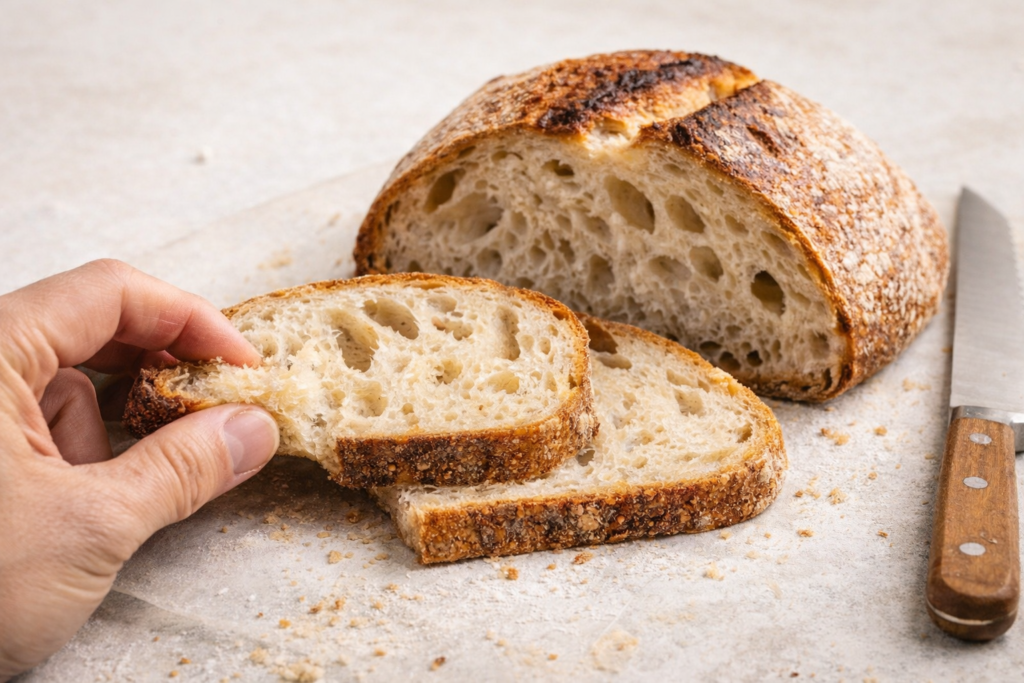
(When fermentation looks correct but the crumb still feels gummy)
Sourdough bakers often encounter a confusing situation: the loaf rises well, the crumb is evenly aerated, and the internal structure looks perfectly normal. There are no obvious signs of under-fermentation, and the crumb is not dense or compressed. Yet when the freshly baked loaf is sliced, the bread feels gummy and difficult to chew, almost springing back between the teeth. Sometimes the crust also loses its crispness quickly and becomes tough and slightly elastic.
If fermentation is clearly successful and the crumb is evenly aerated, a gummy texture is usually caused by an overly strong and elastic dough structure. In wheat sourdough bread, this most commonly happens for three main reasons: excessive acidity, flour that is too strong, or overly developed gluten.
Quick Diagnosis: Fermentation or Something Else?
Before assuming that fermentation went wrong, take a closer look at your loaf. The problem is likely related to excessively strong gluten rather than fermentation if:
- the crumb is evenly aerated, not dense or compressed
- the loaf rose well during both bulk fermentation and final proof
- the crumb structure looks correct when sliced
- but the texture feels rubbery, chewy, or difficult to bite through
- the bread seems to spring back instead of feeling soft and tender
If you observe most of these signs, fermentation is probably not the issue. The dough structure has simply become too tight and too elastic. Below we explain what can cause this and how to correct it.
1. Excess Acidity in the Starter and Dough
Acids produced during sourdough fermentation are a natural and essential part of the process. They shape the flavor of the bread and directly affect the structure of the dough.
When acidity is balanced, acids actually strengthen the gluten network, helping the dough hold its shape. But when too much acid accumulates, the gluten structure can become excessively elastic. The loaf may still have a beautiful, evenly aerated crumb, yet the texture feels gummy.
This often happens when the starter accumulates too much acidity. For example:
- when the starter ferments at very warm temperatures
- when it has been stored in the refrigerator for a long time
- when it hasn’t been refreshed regularly
- when the starter is used past its peak
In these situations the dough may still rise well, but the gluten structure becomes overly tight due to the effect of acidity.
How to fix it
The goal is to strengthen yeast activity and reduce excessive acidity in the starter.
In practice this means:
- refreshing the starter several times before baking, especially after long refrigeration
- avoiding starter that has already passed its peak and started collapsing
- if the starter has gone past peak, feeding it again (even with a small ratio) and letting it rise to peak once more before baking
- avoiding long periods without feeding, especially in warm conditions
Read more about how to recognize a ready starter in the previous Smart Sourdough article.
When yeast activity becomes stronger again, the microbial balance usually returns to normal, acidity decreases, and the crumb becomes softer.
2. Flour That Is Too Strong
Another common cause is very high-protein wheat flour.
Many beginner bakers assume that the higher the protein content, the better the bread will be. However, very strong flour forms a very tight gluten network, which can become even stronger when combined with sourdough acidity. The loaf may look perfectly fine: it holds its shape well, the crumb is airy, and the slice looks neat. But when eaten, the crumb feels overly elastic and difficult to chew.
Very strong flour is usually necessary only in specific situations, such as:
- very high-hydration doughs
- enriched doughs with large amounts of fat or sugar
For most standard sourdough breads, such strong flour is often unnecessary.
How to fix it
Adjusting the flour blend is usually enough.
First, avoid using only very strong flour. You can also add some whole-grain flour, for example around 20% of the total flour. This often softens the crumb while also increasing the nutritional value of the bread.
If you prefer white bread, strong flour can be mixed with all-purpose flour in a ratio like 60:40 or 70:30. This reduces gluten elasticity and usually produces a more tender crumb.
3. Over-Developed Gluten
The third cause is excessive gluten development during mixing.
Bread techniques often emphasize strengthening the dough through kneading, intensive mixing, or repeated folds. This is very helpful when the dough is weak or extremely high in hydration.
However, when flour is already strong and hydration is moderate, intensive mixing can become excessive. The gluten network becomes too tight and elastic, which can lead to a rubbery crumb.
How to fix it
The key is not to overdo intensive mixing, especially when using strong flour and medium or lower hydration dough.
When mixing with a stand mixer, it is usually better to stop earlier rather than developing maximum gluten strength during the initial mixing stage. The dough structure will continue to develop naturally during fermentation.
Folds during bulk fermentation are generally less aggressive and strengthen the dough gradually, so they rarely cause excessive gluten development.
4. The Final Step: Cooling and Patience
Even if the dough was prepared perfectly, bread can still become gummy if it is handled incorrectly after baking. Two common mistakes can undo all the work:
Cutting bread while it is still hot.
After baking, moisture is still migrating inside the loaf and the starch structure has not yet fully stabilized. If the bread is cut too early, steam escapes through the cut and the crumb compresses, becoming sticky or dough-like. Always allow the loaf to cool completely before slicing.
Improper cooling.
Freshly baked bread should cool on a wire rack. If it sits on a baking tray or flat surface, steam accumulates underneath the loaf. Moisture returns into the crumb and crust, making the bottom damp and the crust rubbery. Cooling on a rack allows steam to escape freely.
Summary
If a wheat sourdough loaf has an evenly aerated crumb but still feels gummy when eaten, the most common reason is an overly strong dough structure.
This usually results from three factors: excessive acidity, flour that is too strong or overly developed gluten. In addition, always allow the bread to cool completely on a rack before slicing.
When the balance between starter activity, flour strength, and gluten development is restored, the crumb becomes soft, airy, and pleasant to eat.
Plan your starter peak instead of guessing
Smart Sourdough calculates the estimated peak time based on feeding ratio and temperature, helping you plan your bake more precisely.