
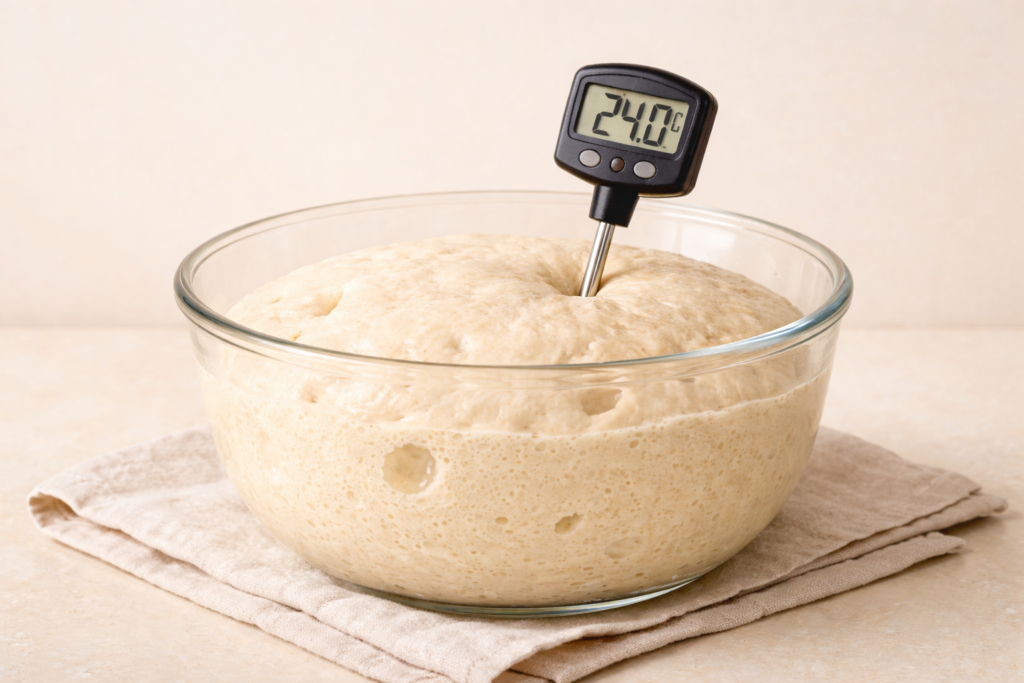
In many sourdough bread recipes you will see the same familiar instruction: “After mixing the dough, let it bulk ferment for 4 hours.”
In practice, this instruction often fails.
The same dough may be ready to shape in four hours one day, yet barely start rising in that time the next. The recipe and ingredients are identical, but the dough behaves completely differently.
The reason is almost always temperature.
Wild yeast and lactic acid bacteria are living organisms. In warmer conditions they become more active, while cooler temperatures slow them down. Dough temperature acts like an invisible speed control that determines how fast the dough rises, how strong the flavor becomes, and whether the loaf will hold its shape in the oven.
Once you understand this principle, sourdough baking stops feeling like guesswork.
What Happens During Bulk Fermentation?
Fermentation begins the moment sourdough starter is mixed into the dough. Inside the bowl, several processes start happening at the same time.
- Gluten develops.
The proteins in the dough begin forming a network. As this structure strengthens, the dough becomes more elastic and better able to trap gas. - Yeast inflates the dough.
Wild yeast consumes sugars present in the flour and produces carbon dioxide. These gases expand the dough and create the open crumb structure. - Lactic acid bacteria build flavor.
These bacteria produce organic acids that give sourdough its characteristic taste while also helping strengthen the dough structure.
Temperature controls the speed and intensity of all of these processes.
How Temperature Affects Sourdough Fermentation Time?
Even a small difference in temperature can shift fermentation timing by several hours. For example, with a typical dough containing about 20% starter, fermentation time might look roughly like this:
| Dough Temperature | Typical Bulk Fermentation Time |
|---|---|
| 21 °C / 70 °F | ~9.5–11.5 hours |
| 24 °C / 75 °F | ~6–7 hours |
| 27 °C / 80 °F | ~4–5.5 hours |
These numbers are approximate because fermentation is also influenced by starter strength, flour type, and hydration. However, the trend remains consistent: higher temperature dramatically speeds up fermentation.
This explains why a recipe that worked perfectly in winter may fail during summer.
Fermentation time depends not only on temperature, but also on the strength of your starter. If your starter is weak or not fully mature, fermentation will slow down significantly. If you’re unsure how to recognize a mature starter, see our guide on when a sourdough starter is actually ready to bake.
The Sweet Spot: Ideal Temperature for Sourdough Dough
Most bakers find the best results when dough ferments between 22–26 °C (72–78 °F).
Within this range fermentation stays balanced. Yeast activity is strong enough for good rise, while lactic acid bacteria develop flavor without weakening gluten too early.
In cooler conditions fermentation progresses more slowly, which often produces a sharper, more acidic flavor.
In warmer environments everything happens much faster. The flavor may become milder and more creamy, but the risk of over-fermentation increases — the dough may become sticky and collapse.
Temperature therefore affects both fermentation speed and flavor balance.
Why You Shouldn’t Rely on the Clock
Recipes that specify only a number of hours can be misleading, because time without temperature has little meaning.
Imagine two bakers using the same recipe. One kitchen is 20 °C (68 °F) while the other is 26 °C (79 °F). If both follow the instruction “bulk ferment for four hours,” they will end up with completely different results. One dough may still be under-fermented, while the other could already be over-fermented and difficult to handle.
For this reason experienced bakers watch the dough itself, not the clock.
How Much Should Dough Rise During Bulk Fermentation?
Instead of measuring fermentation by time, it is much more useful to track dough expansion.
Warmer dough generally requires less rise before shaping because fermentation continues rapidly afterward, even during cold proofing. For example, dough at 26 °C (79 °F) is often shaped when it has increased by about 35% in volume.
Cooler dough typically needs a larger rise before shaping in order to develop sufficient fermentation. At around 20 °C (68 °F), the dough may need to reach roughly 85% expansion before shaping.
Many bakers estimate dough rise visually by marking the initial dough level at the start of bulk fermentation. A transparent container with straight sides works best because the increase in volume is easier to see. Mark the starting level of the dough using a marker, a piece of tape, or another small reference mark on the container. As fermentation progresses, you can compare the dough level to that mark to estimate the rise percentage. For example, a 50% rise means the dough has expanded to about half again its original height.
Monitoring both temperature and rise percentage makes fermentation far easier to understand and control.
A simple rule of thumb: The warmer the dough, the smaller the rise needed before shaping.
Why Fermentation Is Hard to Control in Home Kitchens?
Professional bakeries often use fermentation cabinets or temperature-controlled rooms. Home kitchens rarely have this level of stability.
Your kitchen might be:
- 19 °C (66 °F) in winter
- 23 °C (73 °F) in spring
- 27 °C (81 °F) in summer
Each of these temperatures dramatically changes fermentation speed.
This is why many home bakers feel that sourdough is unpredictable. A recipe that worked perfectly last month may behave completely differently when the kitchen temperature changes.
How to Take Control of Fermentation?
It helps to think of fermentation as a process governed by measurable variables: temperature and rise.
Dough temperature determines how quickly fermentation progresses, while dough expansion shows how far fermentation has advanced and when shaping should begin.
A few practical tips can make this process easier:
- Measure dough temperature. A simple kitchen thermometer provides far more useful information than the clock.
- Adjust water temperature. If your kitchen is cold, use warmer water when mixing the dough. If it is hot, use cooler water.
- Monitor rise level and end bulk fermentation at the right point based on dough temperature.
- Plan fermentation more precisely. The Smart Sourdough app automatically estimates fermentation timing and recommended rise percentage based on dough temperature and starter percentage. This helps bakers plan fermentation instead of relying on guesswork.
How to Recognize Fermentation Problems?
Understanding temperature also helps diagnose common baking issues:
- Under-fermented dough. The baked loaf tends to be dense, tight, and sometimes gummy. This usually happens when fermentation was too short for the given temperature.
- Over-fermented dough. The dough becomes sticky and weak, spreads during shaping, and produces a flat loaf with poor oven spring. This typically occurs when the dough fermented too long in warm conditions.
In both cases the problem is not simply time, but the relationship between time and temperature.
Conclusion
Dough temperature is one of the most important variables in sourdough baking. It determines fermentation speed, flavor development, and whether the dough is properly prepared for shaping.
Once you begin monitoring both temperature and dough rise, sourdough baking becomes far more predictable. Instead of fighting the dough, you start understanding how it behaves.
This simple shift in approach can dramatically improve the consistency and quality of your bread.
Frequently Asked Questions
What temperature is best for sourdough fermentation?
Most bakers aim for 22–26 °C (72–78 °F) during bulk fermentation. This range keeps fermentation active while maintaining strong dough structure.
How does temperature affect fermentation time?
Warmer dough ferments faster because yeast and bacteria become more active. For example, dough at 27 °C (81 °F) may ferment roughly twice as fast as dough at 21 °C (70 °F).
Should I measure dough temperature or room temperature?
Dough temperature is more important. It can differ from room temperature due to water temperature, flour temperature, or mixing friction.
Can sourdough ferment at lower temperatures?
Yes, but fermentation will take longer. Cooler fermentation often produces a deeper, more sour flavor that some bakers prefer.
Stop guessing. Bake with a system
With Smart Sourdough you know how much your dough has to rise, and no longer guess how long it will take.